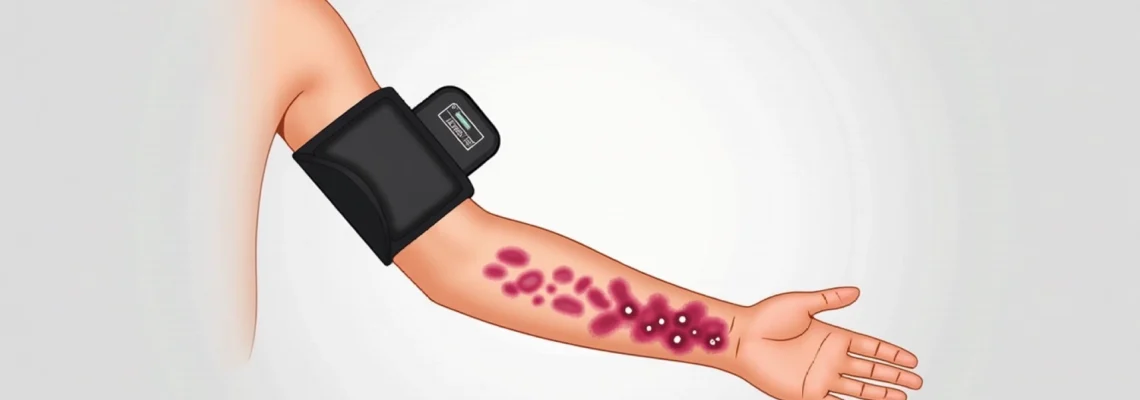
Blood pressure monitoring represents one of the most fundamental diagnostic procedures in modern healthcare, yet its potential to cause tissue trauma often goes unrecognised. When patients develop unexplained bruising, ecchymoses, or petechial lesions following routine vital sign monitoring, healthcare professionals may overlook the mechanical nature of sphygmomanometry as a contributing factor. Understanding the mechanisms behind blood pressure cuff-induced bruising becomes particularly crucial when distinguishing between equipment-related trauma and underlying pathological conditions such as vasculitis or bleeding disorders.
The phenomenon extends beyond simple mechanical pressure application. Recent clinical observations have documented cases where pneumatic compression from automated blood pressure devices has triggered or accelerated inflammatory vascular responses, creating diagnostic challenges that require careful consideration of both technical factors and patient-specific risk profiles.
Pathophysiology of blood pressure Cuff-Induced petechiae and ecchymoses
The physiological response to blood pressure cuff inflation involves complex interactions between mechanical compression, vascular integrity, and haemostatic function. When pneumatic pressure exceeds normal venous return pressure, localised blood stasis occurs, creating conditions that predispose to microhaemorrhage formation. This process becomes particularly pronounced when measurements are repeated frequently or when inflation pressures substantially exceed systolic blood pressure values.
Capillary fragility response to sustained pneumatic compression
Capillary fragility testing has long demonstrated the vulnerability of superficial vessels to sustained pressure application. During blood pressure measurement, cuff inflation creates a tourniquet effect that temporarily compromises venous drainage whilst maintaining arterial inflow at pressures below systolic values. This differential pressure gradient causes capillary engorgement and potential rupture, particularly in patients with compromised vascular integrity or those taking antiplatelet medications.
Tourniquet effect mechanisms in sphygmomanometry procedures
The tourniquet effect generated during blood pressure measurement mirrors the controlled ischaemia used in surgical procedures, albeit at lower pressures and shorter durations. However, repeated applications can produce cumulative tissue stress. Research indicates that sustained pressure above 40 mmHg can impair lymphatic drainage, whilst pressures exceeding 80 mmHg compromise venous return, creating ideal conditions for interstitial fluid accumulation and subsequent bruising formation.
Vascular permeability changes during oscillometric measurements
Oscillometric blood pressure devices rely on detecting arterial pulsations during gradual cuff deflation. This process requires multiple inflation-deflation cycles, each potentially triggering inflammatory mediator release. Histamine and other vasoactive substances may be released locally, increasing vascular permeability and facilitating extravasation of blood components into surrounding tissues. The repetitive nature of these measurements in critical care settings compounds this effect significantly.
Haemostatic dysfunction contributing to Post-Cuff haematomas
Patients with underlying haemostatic dysfunction face increased risk of post-measurement bruising. Platelet aggregation may be temporarily impaired by the mechanical stress of cuff compression, whilst coagulation factor activity can be locally altered by tissue hypoxia. Additionally, the shear stress generated during rapid cuff deflation may activate platelets inappropriately, potentially triggering microthrombus formation followed by subsequent bleeding when normal circulation resumes.
Technical parameters of automated BP monitors causing tissue trauma
Modern automated blood pressure devices incorporate sophisticated algorithms designed to optimise measurement accuracy whilst minimising patient discomfort. However, technical malfunctions or inappropriate parameter settings can significantly increase the risk of tissue trauma. Understanding these technical aspects enables healthcare professionals to identify potentially problematic devices and implement appropriate safeguards.
Omron HEM-7120 inflation pressure calibration issues
The Omron HEM-7120 series utilises adaptive inflation technology that should theoretically reduce unnecessary pressure application. However, calibration drift can result in excessive inflation pressures, particularly in devices with high usage frequencies. Calibration protocols recommend quarterly verification , yet many clinical environments fail to implement systematic maintenance schedules. When inflation pressures exceed 200 mmHg routinely, the risk of cuff-induced trauma increases exponentially, particularly in elderly patients with fragile skin integrity.
Welch allyn FlexiPort cuff material composition and skin reactions
FlexiPort cuff technology incorporates latex-free materials designed to minimise allergic reactions. However, the specific polymer composition can interact with certain topical medications or skin care products, potentially creating localised inflammatory responses that may be mistaken for pressure-induced trauma. The textured inner surface, whilst designed to prevent slippage, can create friction-related microtrauma during repeated applications, particularly when cuffs are applied over clothing or bandages.
Philips SureSigns VS2+ deflation rate programming errors
Deflation rate programming errors in the SureSigns VS2+ can create rapid pressure changes that stress vascular walls beyond their elastic limits. Optimal deflation rates of 2-3 mmHg per heartbeat minimise shear stress, but programming errors may result in deflation rates exceeding 10 mmHg per second. Such rapid pressure changes can cause vessel wall damage similar to that seen in decompression injuries, leading to delayed bruising that may not manifest until hours after measurement.
Criticare systems 506N3 oscillometric algorithm malfunctions
Algorithm malfunctions in the 506N3 can result in excessive re-inflation attempts when oscillometric signals are unclear. This repetitive cycling creates cumulative tissue stress that may not be immediately apparent but can manifest as delayed bruising or petechial formation. The device’s error-handling protocols may not adequately account for patients with irregular cardiac rhythms or significant peripheral vascular disease, leading to prolonged measurement attempts and increased tissue trauma risk.
Clinical observations suggest that patients requiring blood pressure monitoring every 10 minutes for extended periods may develop progressive tissue compromise, even with properly functioning equipment.
Patient-specific risk factors for Sphygmomanometer-Related bruising
Individual patient characteristics significantly influence susceptibility to blood pressure cuff-induced trauma. Age-related changes in skin elasticity, concurrent medications affecting haemostasis, and underlying medical conditions all contribute to varying degrees of vulnerability. Recognising these risk factors enables targeted prevention strategies and helps differentiate between equipment-related trauma and pathological bleeding disorders.
Anticoagulant therapy impact on Cuff-Induced bleeding
Patients receiving anticoagulant therapy face substantially elevated risk of cuff-induced bruising. Warfarin therapy, particularly when International Normalised Ratio values exceed 3.0, creates conditions where minimal trauma can result in extensive ecchymosis formation. Novel oral anticoagulants such as dabigatran and rivaroxaban may produce different bleeding patterns, often characterised by more discrete, well-demarcated haematomas rather than the diffuse bruising typically associated with warfarin therapy.
Geriatric skin atrophy and subcutaneous vessel vulnerability
Age-related skin changes dramatically increase susceptibility to pressure-induced trauma. Dermal atrophy reduces protective cushioning around superficial vessels, whilst decreased collagen production compromises vessel wall integrity. Elderly patients frequently demonstrate purpura formation at pressures well below those required to cause trauma in younger individuals. The phenomenon becomes particularly pronounced in patients with chronic steroid exposure or significant sun damage, where skin fragility reaches extreme levels.
Thrombocytopenia complications during routine BP monitoring
Thrombocytopenic patients require special consideration during blood pressure monitoring procedures. Platelet counts below 50,000 per microlitre significantly increase bleeding risk, even with minimal trauma. The mechanical compression associated with blood pressure cuff application can trigger platelet consumption, potentially worsening existing thrombocytopenia. Automated devices may compound this risk through repetitive inflation attempts when initial measurements prove difficult to obtain.
Corticosteroid-induced purpura susceptibility in hypertensive patients
Chronic corticosteroid therapy creates a unique vulnerability profile characterised by skin fragility and impaired wound healing. Patients receiving prednisolone equivalent doses exceeding 20mg daily demonstrate significantly increased susceptibility to cuff-induced trauma. The combination of steroid-induced skin atrophy and hypertension requiring frequent monitoring creates a perfect storm for progressive tissue damage. Steroid purpura typically presents as well-demarcated lesions that may be difficult to distinguish from equipment-related trauma without careful history taking.
Manual sphygmomanometer technique errors leading to haematoma formation
Manual blood pressure measurement techniques, whilst considered the gold standard for accuracy, introduce human factors that can significantly increase tissue trauma risk. Improper cuff sizing represents the most common technical error, with oversized cuffs requiring excessive pressure to achieve accurate readings and undersized cuffs creating focal pressure points that damage underlying tissues. The bladder width should encompass approximately 40% of arm circumference, whilst bladder length should encircle at least 80% of the limb to distribute pressure evenly.
Rapid inflation techniques often employed in emergency situations can create pressure spikes exceeding 300 mmHg, well above levels necessary for accurate measurement. Such extreme pressures can cause immediate vessel wall damage, particularly in elderly patients or those with compromised vascular integrity. Proper inflation technique requires gradual pressure application whilst palpating the radial pulse, inflating 20-30 mmHg above the point where the pulse disappears.
Deflation rate control presents another critical technical factor. Excessive deflation rates, commonly seen when healthcare providers attempt to expedite the measurement process, can create turbulent flow conditions that stress vessel walls. The optimal deflation rate of 2-3 mmHg per heartbeat ensures accurate reading whilst minimising mechanical trauma. Conversely, excessively slow deflation rates, whilst potentially more accurate, prolong tissue compression time and may increase the risk of ischaemia-related complications.
Research indicates that healthcare providers often underestimate the pressure required to cause tissue trauma, with studies showing that pressures as low as 60 mmHg can trigger petechial formation in susceptible individuals.
Differential diagnosis between Cuff-Induced bruising and systemic bleeding disorders
Distinguishing between mechanical trauma from blood pressure measurement and underlying pathological bleeding represents a critical diagnostic challenge. The pattern, timing, and progression of lesions provide valuable diagnostic clues. Cuff-induced trauma typically demonstrates sharp demarcation corresponding to cuff boundaries, with maximum intensity at the distal edge where venous congestion is greatest. The lesions generally remain localised to the area of direct pressure application and resolve progressively over 7-14 days without spreading to other anatomical regions.
Systemic bleeding disorders, conversely, typically present with more generalised distribution patterns and may demonstrate progression to previously unaffected areas. Thrombocytopenic purpura characteristically involves dependent areas and mucous membranes, whilst coagulopathic bleeding tends to occur in areas of minor trauma or spontaneously in soft tissues. Leukocytoclastic vasculitis, as documented in clinical case reports , may initially present as localised purpura but subsequently spreads to multiple limb involvement with characteristic inflammatory features including warmth and induration.
Laboratory investigations play a crucial role in differential diagnosis. Complete blood count with platelet evaluation, coagulation studies including prothrombin time and activated partial thromboplastin time, and comprehensive metabolic panels help identify underlying haemostatic dysfunction. In cases where vasculitis is suspected, inflammatory markers including erythrocyte sedimentation rate and C-reactive protein provide valuable diagnostic information. Complement studies and antineutrophil cytoplasmic antibody testing may be indicated when systemic vasculitis is suspected.
Temporal relationships between blood pressure monitoring and lesion development provide additional diagnostic insight. Cuff-induced trauma typically manifests within hours of measurement, with maximal intensity developing within 24-48 hours. Systemic conditions may demonstrate delayed onset patterns or correlation with medication initiation rather than mechanical procedures. The response to cessation of blood pressure monitoring often provides definitive diagnostic clarification, with mechanical trauma showing rapid improvement whilst pathological conditions typically progress despite elimination of the presumed inciting factor.
Evidence-based prevention strategies for BP Measurement-Related skin trauma
Implementing systematic prevention strategies requires understanding both equipment-specific factors and patient-individual risk assessments. Cuff rotation protocols represent the most fundamental preventive measure, with guidelines recommending alternating between arms every 8 hours during continuous monitoring. This approach distributes mechanical stress across multiple sites whilst allowing recovery time for previously compressed tissues. However, in patients with unilateral vascular access or significant asymmetrical blood pressure readings, modified rotation schedules may be necessary.
Appropriate cuff sizing cannot be overemphasised as a preventive strategy. Many healthcare facilities maintain limited cuff sizes, forcing staff to use suboptimal equipment that increases trauma risk. Investment in comprehensive cuff inventories including paediatric, standard adult, large adult, and thigh cuffs ensures appropriate sizing for all patient populations. Cuff sizing charts should be readily available at all monitoring stations, with staff training emphasising the importance of proper measurement techniques.
Pressure limitation protocols deserve consideration in high-risk patients. Many modern devices allow maximum inflation pressure programming, enabling customised limits based on individual patient factors. Elderly patients, those receiving anticoagulation therapy, or individuals with known bleeding disorders may benefit from maximum inflation pressures limited to 180-200 mmHg rather than default settings that may exceed 250 mmHg. Such modifications typically maintain measurement accuracy whilst significantly reducing trauma risk.
- Implement systematic cuff rotation protocols with documented timing intervals
- Ensure comprehensive cuff sizing inventories across all patient care areas
- Programme appropriate maximum inflation pressures for high-risk patients
- Establish regular equipment calibration and maintenance schedules
- Provide ongoing staff education regarding proper measurement techniques
Skin protection measures offer additional preventive benefits, particularly for extended monitoring periods. Protective sleeves or padding placed beneath cuffs can reduce friction whilst maintaining measurement accuracy. However, such interventions must be validated for specific device types to ensure they do not interfere with oscillometric detection algorithms. Regular skin assessment protocols enable early identification of developing trauma, allowing for intervention before significant tissue damage occurs.
Documentation strategies should capture both measurement frequency and any observed skin changes to facilitate pattern recognition and risk assessment. Electronic health records can be configured to prompt staff regarding appropriate rotation timing and high-risk patient identification. Quality improvement initiatives focused on blood pressure measurement-related trauma can identify institutional patterns and guide targeted interventions. Such systematic approaches demonstrate measurable reductions in patient complications whilst maintaining measurement quality and clinical safety standards.
Prevention strategies must balance the clinical necessity of frequent blood pressure monitoring with the potential for iatrogenic complications, requiring individualised risk-benefit assessments for each patient situation.